


TRUST ISSUES: COLLISION
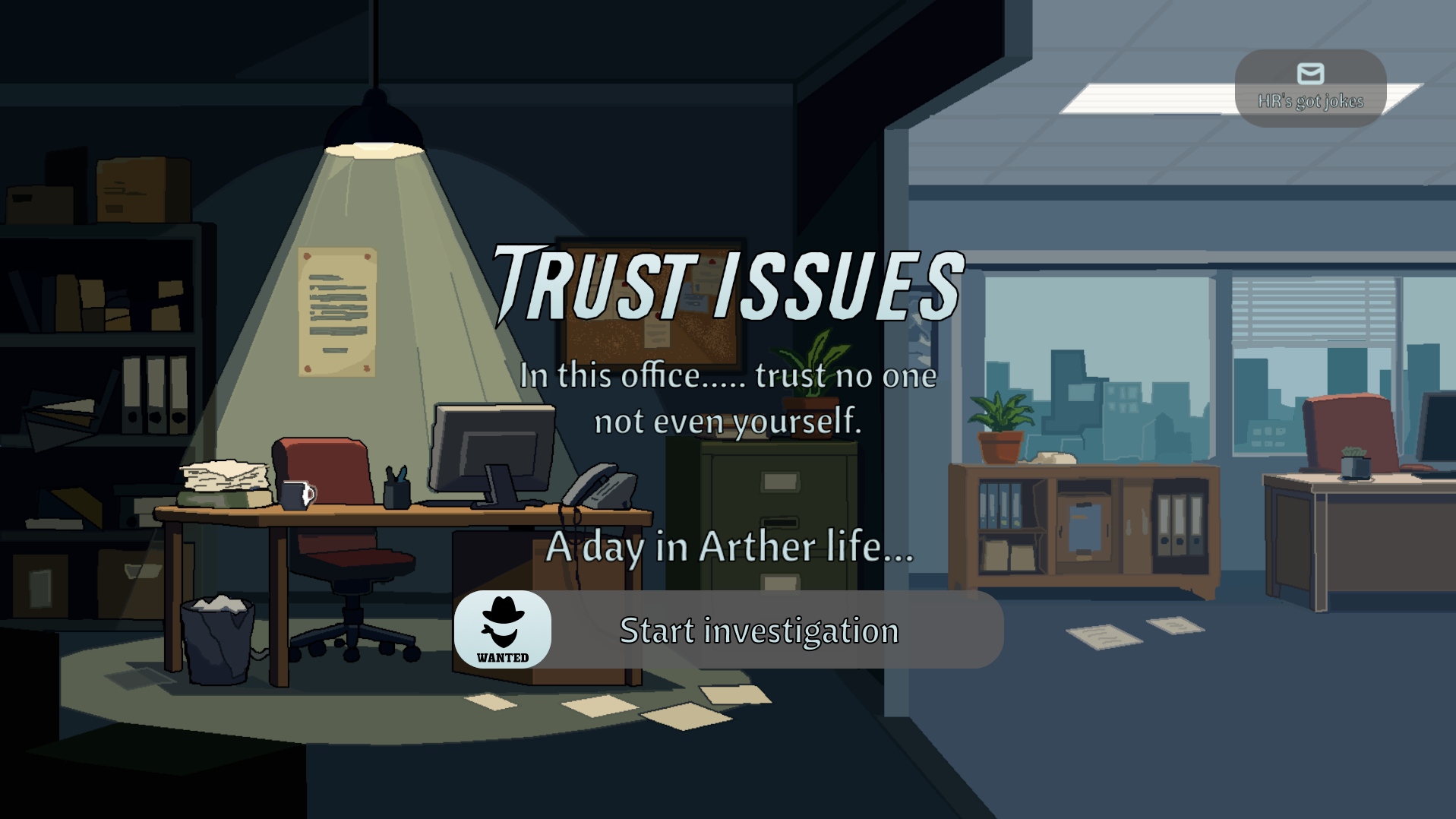
TRUST ISSUES
Sometimes, the problem isn't who you're looking for. It's the story your own mind built.
Something is wrong at the office.
Something is missing.
And Arthur is absolutely certain that someone is responsible.
There are suspicious coworkers. Contradictory statements. Strange evidence. And a very limited amount of time to figure out what’s really going on.
But the more Arthur investigates, the less things seem to make sense.
Because when you start looking for a conspiracy everywhere...
you might find one.
Or maybe nobody in this office is normal.
INVESTIGATE
Interrogate your coworkers, examine the evidence, and connect the contradictions.
Everyone has something to hide.
The question is:
Does it actually matter?
WATCH YOUR PARANOIA
Every wrong move pushes Arthur further down the rabbit hole.
As paranoia rises, the pressure rises with it.
Your decisions don't just change what you believe.
They change the way the game feels.
TIME IS RUNNING OUT
You don't have forever to solve the case.
Search. Question. Connect the dots.
Then make your accusation.
Choose carefully.
EVERY CASE HAS A SECRET
Trust Issues is a series of strange workplace investigations where nothing is quite as simple as it seems.
New cases. New mysteries. New suspects.
And the deeper you go...
the harder it becomes to know what—or who—to believe.
Can you solve the case?
Or will you discover that you were never investigating the right person?
Case closed. Or is it?
HOW TO PLAY
You are Arthur. Something is missing. You have a few minutes, a handful of coworkers, and a drawer full of evidence. One of them is lying to you — the other two are just being normal, weird, human coworkers.
1. Investigate, in any order.
Question Kevin, Sarah, and Brenda (and anyone else in the room) however you like.
There's no wrong order — only wrong evidence.
2. Pick your evidence carefully.
The Evidence Drawer holds everything you've collected.
Each suspect has exactly one piece of evidence that actually applies to them.
Present the wrong one, and:
- Arthur's Paranoia rises.
- The clock loses time — a fixed penalty, on top of the seconds already ticking away.
Wrong guesses aren't free.
They cost you the one resource you can't get back:
Time.
3. Watch the Paranoia Meter.
Every wrong guess pushes it higher.
At 100%, something changes — the countdown itself starts moving faster.
Time doesn't just run out anymore; it runs away from you.
The more mistakes you make, the less time your remaining mistakes can afford.
4. Read the reaction, not just the result.
Correct evidence gets a reaction out of every suspect — but how they react is the real clue.
A closed, complete answer means they've told you everything.
An answer that trails off, deflects, or refuses to finish the sentence means there's still something they're not saying.
5. Make your accusation.
When the investigation ends — by the clock or by exhausting your evidence — you'll be asked one question:
Who is lying?
Choose carefully.
Getting it right reveals the truth.
Getting it wrong means starting the case over.
6. Remember what you're actually solving.
Finding the liar isn't the same as finding a thief.
Those might turn out to be two very different questions.
Leave a comment
Log in with itch.io to leave a comment.